Saturday, June 16, 2018

Nancy Jane "Bradley" (1855-1926): Daughter of James Pettry (1831-1909)

*Edit* With the help of my wonderful readers, I found out that Joshua Bradley had actually passed away by the time that Nancy Jane "Bradley" was born, and that was why it was recorded that Nancy was "sworn to James Petry." I will leave the post here for archival purposes. Many thanks!

In this blog I ordinarily feature ancestors who have proven to be a challenge to research, so that the methods used to find them might help someone else with a similar issue. The ancestors written about in this post weren't particularly difficult to research, but the situation does present a certain mystery. This case is unique in that the mystery lies not in the who, but in the why.

Many years ago, when I first became interested in genealogy, I found my name in a descendant report for Martin Pettry, who was supposedly an ancestor my Great-Grandpa Quinn through his mother's side. Grandpa Quinn's mother, Nancy, was listed as the daughter of James Pettry and Lucinda Brown. Being a newby genealogist, I took this as fact and didn't question it. When I decided that I needed to start keeping all of my genealogy info in one place and started using Ancestry.com, I was surprised to find that all of the hints I was getting for Nancy Jane Pettry referred to her as Nancy Jane Bradley.

Nancy Jane Petry Quinn,
circa 1920.
A look at the records provided by Ancestry's hints told me that Nancy's father was apparently Joshua Bradley, who was indeed married to her mother, Lucinda Brown, at the time of her birth. Nancy's death record and Social Security index record both listed Joshua as her father. Mentally chiding the researcher who had put together the Pettry report, I changed Nancy's last name in my tree to Bradley and continued to work on Joshua Bradley's branch - some parts of which went back for many more generations.

After successfully joining the DAR last month, I started looking around in my tree for ancestors that I could easily find records for in order to submit as supplemental ancestors. I decided to get records together for James Madison Crews, an ancestor of Joshua Bradley; since he already had many descendants listed in the DAR's database, I knew that they would have many of the records that I needed in order to prove descent. I began working from myself backward, making sure that I had birth, marriage, and death records for each ancestor in the line of descent.

Nancy "Bradley"'s birth record
(highlighted).
When I looked up the original image of Nancy's birth record, my heart sank. Her name was indeed listed as Nancy Bradley, but in the space designated for the name of the father was written "Bastard (sworn to James Pettry)". Her mother, Lucinda Bradley, had been the informant.

A look through my mother's DNA matches turned up about half a dozen forth cousins who all descended from James Pettry's father, and none that descended from Joshua Bradley's father. The DNA evidence confirmed Nancy's birth record - she was the daughter of James Pettry after all. The original researcher who made the Pettry descendant report had been correct, and I had to do some major editing to my tree.

Lucinda Brown Bradley with
her husband, Joshua Bradley.
After the initial shock and subsequent excitement (after all, I had a whole new branch of ancestors to find!), I started to wonder about the circumstances that lead to the writing on that birth record. Lucinda had made sure that her daughter's birth date was recorded, and she made sure that James Pettry was recorded as her child's biological father. Why would a woman do such a thing in 1855? Surely she would want everyone to believe that her husband was her daughter's father?

Was Lucinda assaulted, and this was her way of making sure that James was held responsible? Did James' family have money, and this was a way to make sure her daughter was provided for? Was it as simple as Lucinda having an affair? All of these thoughts and emotions ran through my mind when I saw Nancy's birth record. I'm still not sure what to think or feel, but I desperately want to know why Lucinda made sure that James was recorded as Nancy's father. I will never know for sure, but I can at least try to make an educated guess.

Can anyone give me some insight into this situation? Why would a woman purposefully admit that she gave birth to an illegitimate child out of wedlock in 1855, when the model of femininity was the "Angel in the House"? Please let me know what you think.


Sunday, May 27, 2018

DNA - Good Enough for the DAR?

Part of the fun of being a genealogist is being familiar with all of the societies that you are eligible to join as a result of your descent from certain groups of ancestors. I am being officially inducted into the Anne Bailey Chapter of the National Society of the Daughters of the American Revolution next month, along with my mother and grandmother. I also have ancestors that make me eligible for most of the other major societies, including the Daughters of 1812, Daughters of the Confederacy, Associated Daughters of Early American Witches, Winthrop Society, Colonial Dames of the 17th Century, and the Jamestown Society. Much to my aggravation, I have yet to find an ancestor making me eligible for the Mayflower Society.

All of these societies require documented proof for each generation that connects you to the qualifying ancestor, including birth, marriage, and death information. This information can sometimes be very challenging to obtain for various reasons - courthouse fires, lack of proper record-keeping, and name misspellings are the usual culprits. Sometimes, if you're lucky, family genealogy books tracing a single family name or all of the descendants of one ancestor were written before the original documents were destroyed; but even then, the books are only accepted in specific cases. In many cases, you might know that you descend from a specific ancestor because of family tradition, letters, Bible records that are no longer accessible to you, etc., and not have the official records to prove it because of one of the reasons listed above.


This person who matches my grandmother's DNA descends
f
rom John McClung, the father of our DAR ancestor, 
Samuel McClung. This is an example of an ancestor
"hint" received on Ancestry when two DNA matches
have the same ancestor in their tree.
There have been so many occasions when I wished that the DAR (or any of the other societies) would accept Ancestry DNA results as proof of lineage. Ancestry has a "hints" system in its interface for DNA matches, which points shows you how you are related to someone that you match with. If you and the DNA match have the same ancestor in your trees, you both receive a "hint." Not exactly 100% concrete with just one match, but if you have several hints that all connect back to the same ancestor, I would say that it is beyond reasonable doubt that you are both descended from the same ancestor. 

The DAR began accepting Y-DNA results (which can only be carried through direct male lines) as a supplement to applications in 2014, but you still have to have exact documentation for every generation. As far as I know, the DAR is the only society that accepts even Y-DNA, although I'm not really sure what the advantage of submitting it would be. This is the explanation that the DAR gives: 

"DAR begins accepting Y-DNA evidence, effective January 1, 2014, in support of new member applications and supplemental applications. DNA evidence submitted along with other documentation will be considered along with all of the other source documentation provided to prove heritage. Y-DNA will not be considered as stand-alone proof of linage because, while it can be used as a tool to point to a family, it cannot be used as absolute proof for an individual. For those applicants wishing to submit DNA evidence as proof of lineage along with their other traditional proof documentation, they must submit Y-DNA test results from at least two test subjects following criteria outlined in the guidelines and test requirements for Using DNA Evidence for DAR Applications." (The source for this quote can be found here.)

I hope that at some point in the near future, genealogical societies will begin to take autosomal DNA results (the scientific name for Ancestry DNA, which can be carried through men or women) as an acceptable proof of lineage, or perhaps in support of other documentation that is less exact, such as census records prior to 1850. Perhaps the following rules could be put in place:

1. The DNA matchs must be within a certain number of generations (say, no more than 8).
2. You must produce at least 3 DNA matches who descend from the same ancestor.
3. At least one of the DNA matches must already be a member.

What are your thoughts on genealogical societies accepting autosomal DNA as proof of lineage? Please let me know!

Sunday, May 20, 2018

Ka-Okee: Daughter of Pocahontas or Genealogy Legend?

The internet is now full of stories about Ka-Okee, the supposed lost daughter of Pocahontas and her first husband, the warrior Kokoum. While many people embraced the story immediately, others have been quick to immediately dismiss it as the stuff of genealogical fairy-tales.

The only portrait of Pocahontas made
during her lifetime.
I first found the story of Ka-Okee when researching a line of my own family. If the pieced-together pedigrees are to be believed, I am descended from Ka-Okee through her daughter, Christian Pettis, and her granddaughter, Ann Martin, who married Edward Watts.

The line has been researched and documented with primary source documents by me up through the marriage of Ann Martin and Edward Watts. When I did a Google Books search for the two names together to see if anything else would come up, I came across the book Shawnee Heritage IV by Don Greene, who connected the couple to Ka-Okee via Christian Pettis. When I saw that Ka-Okee was apparently the daughter of Pocahontas, I had to know more.

I quickly came upon two blog posts on the subject - one embracing it as truth, and one instantly and flippently dismissing it as fiction. It was clear that I wasn't going to get unbiased opinions here, so I set out to find the truth of the matter and to draw my own conclusions.

I quickly found the original Patawomeck Tides newsletter where the story of Ka-Okee made its debut. The basic premise of the tribal historian, Bill Deyo, seemed to be simple enough: he knew of several families who claimed descent from Pocahontas according to their family traditions, but none of them descended from the Bollings (the family from which all of Pocahontas' documented descendants come, via her granddaughter, Jane Rolfe, who married a Bolling). They did, however, all descend from the Martin and Pettus families. There was already a long-standing oral tradition in the Martin family that one of their early colonial ancestors had married a Native American girl named Ka-Okee. Deyo knew that Ka-Okee must connect to Pocahontas somehow, but he did not know exactly how.


It was then that Bill Deyo discovered the book The True Story of Pocahontas: The Other Side of History by Dr. Linwood "Little Bear" Custalow and Angela L. Daniel "Silver Star." In this book, Angela L. Daniel recorded the sacred oral history of the Mattaponi tribe, as told by Dr. Custalow, their chief. The oral tradition had been passed down from generation to generation for hundreds of years, and had never before been recorded in writing. The Mattaponi people were the tribe of Pocahontas' mother. The book confirmed what Deyo had already been thinking - that there must have been another child besides Thomas Rolfe, the child of Pocahontas and John Rolfe. Deyo then concluded that as all lines led back to the Martin family, the child must have married into the family at some point, and that this child must have been Ka-Okee, the Native American ancestor that had been part of their family traditions for generations.

After purchasing the book and reading it, I confirmed one interesting point. As Bill Deyo points out in the Patawomeck Tides newsletter, the tribe really did not know much about the child of Pocahontas and Kokoum, other than the fact that a child existed. In the timeline at the end of the book, the authors state that "[between 1610 and 1612] Pocahontas came of age. She was about thirteen years old. Pocahontas fell in love with and married Kokoum, an elite Patawomeck warrior and a guard at Werowocomoco. They eventually moved to the Patawomeck tribe and had a child. Because the baby's name is not known, he is referred to in the manuscript as "Little Kokoum." If the name of the child was not known, it is reasonable to speculate that the gender of the child might also have been unknown; the child could just as easily have been a daughter as a son.

Up to this point, I have only given a summery of what I found while researching. Here is my interpretation of the information found, and my opinion on Ka-Okee:

  1. The book The True Story of Pocahontas should be considered a credible source, and the assertion that Pocahontas and Kokoum had a child together should be taken as fact. The book was originally a dissertation, written as the final step in Angela Daniel's requirement to earn a Ph.D. in anthropology from the College of William and Mary, an Ivy League institution (see the acknowledgements at the end of the book). This manuscript had to go through a rigorous processes of review from a dissertation committee made up of experts in the field, and everything in the manuscript that could be confirmed via documentation was in fact documented. If a committee of experts in the field are willing to accept these assertions from the Mattaponi tribe as fact, so should we.
  2. William Strachey, a member of the Virginia Company, wrote in 1612 that Pocahontas was married to Kokoum for at least two years. Two years is plenty of time in which to have a child. Yes, the couple would have been very young; but during the early 17th century, young girls were frequently married in their early teenage years and bore children soon thereafter.
  3. All of the families mentioned by Deyo in the newsletter do descend from the Martin and Pettis/Pettus families. William Pettus, an accomplished genealogist who has published two volumes on the Pettis/Pettus family, has accepted the Ka-Okee story as true. You can read his comments on the story here.
  4. Whether the child was a boy or a girl, the child most likely does have hundreds of descendants by now. The number of Pocahontas descendants who descend from Thomas Rolfe number in the thousands, including two former first ladies of the United States. It would be reasonable to assume that the first child's descendants would be similar in number, and likely have a few notables among them.

Based on the available information, I absolutely believe that Pocahontas and Kokoum had a child. I believe that it is very likely that this child was female, and that this is a huge part of the reason why this story has not been known until now. I believe that it is very possible that the child was the Native American woman who apparently married Thomas Pettus, known as Ka-Okee.

Will we every know the story in it's entirety? No. Will we ever know for sure if the child was male or female? With the advances in Ancestry DNA testing, it's quite possible. Will we ever find a contemporary written reference to any of this? It's possible, but probably not.

I would love to hear your thoughts on this story, particularly if any professional genealogists ever happen across this page. It is an intriguing story, and one that, if proven true, could change our entire outlook on early colonial Native American genealogy.

Saturday, March 17, 2018

Rebecca J. Ratliff (c.1852-1927): The Mystery Solved

In October I wrote this blog post about my third-great-grandmother, Rebecca J. Ratliff Moore, and how the identities of her parents have been a mystery for decades; in fact, they were apparently a mystery to Rebecca's own children. For years and years I searched, hoping to one day get to tell my great-grandmother who her great-grandparents were. Unfortunately, she passed away before I got the chance to do that.

The previous post explained a wild theory that I had about Rebecca, but of course it could only ever be a theory at best. I had almost given up hope of ever knowing for sure who Rebecca's parents were. Every time I went back to work on it, I would simply get frustrated and put it away again.

A few days ago a contacted a fellow researcher on Find-A-Grave who, as it turns out, I was loosely acquainted with in real life. I had originally contacted her about the matter of linking John Harmon Moore's (Rebecca's son) profile to that of his half-sister, Martha Moore Backus. She decided to do some background research on them, and happened across my original blog post about Rebecca. The mystery intrigued her, so she decided to look into it for me. And all I can say is: God bless this woman.

She told me that when researching in the Pike Co., KY area, she always checks the surrounding counties as well, because within 20 miles or so three states border one another: Pike Co., KY; Buchanan Co., VA, and Mingo Co., WV. So she searched records in Buchanan Co. for Rebecca's family, and I'll be if she didn't solve a decade's long search in a matter of hours.

Richard Ratliff's family, listed in the 1860 census.
She found a six-year-old Rebecca Ratliff in the household of Richard and Matilda Jasper Ratliff in Buchanan Co., VA in the 1860 census, along with siblings Wilbourn and Sarah (among others). She went on to find that Wilbourn, whose name is often mistakenly written as William, moved to Clay County, WV and married a woman named Mary Catherine Bird, and that Sarah married a man named James Hackney and moved to Blakely, WV: which is where Rebecca was living when she died.

The researcher gave a number of other records to support her findings, but as soon as I saw that Wilbourn and Sarah were her siblings and who they had married, I knew that we had the right family. My grandmother, my mother, and I all have many DNA matches that descend from Wilbourn and Sarah. In fact, I had even looked into both couples myself in the past, but although I knew that they had to somehow connect to the same family, I couldn't see past the "Pike Co., KY" info listed on a couple of Rebecca's records, and therefore couldn't come to the conclusion that they were siblings. It took a set of fresh eyes with a fresh idea to make everything fall into place.

After reading the researcher's email, I burst into tears. I couldn't believe that after all this time, I finally had the answers that I had sought for so long. My second thought was that I wished that my great-grandmother had been here to see this. But, I have a feeling that she knows.

For those who read my first post about Rebecca, you may remember that I had said that I had DNA matches that descended from the grandparents of the "other" Rebecca J. Ratliff, who had married Nathan Frasher. As it turns out, the two Rebeccas are third cousins. They had the same Ratliff great-great-grandfather. No wonder DNA didn't help me much with my initial search...

I am still experiencing so many emotions because of this discovery, and I am amazed and overwhelmed by the generosity of the researcher and her willingness to help a near-stranger without even being asked. It's the moments like this - the discoveries, and the people who help us make them - that make this entire endeavor worth it. And now, I am SO happy to say in writing, for the first time ever, that:

Rebecca J. Ratliff (born between 1852 and 1854, died May 6, 1927) was the daughter of Richard Ratliff and Matilda Jasper. She married Josiah Moore, son of Joseph Moore and Hannah Cady, on February 3rd, 1887. They had two children: John Harmon Moore (1888-1957) and Luthara Grace Moore (1889-1952).
***

Wednesday, October 25, 2017

Rebecca J. Ratliff: Frasher, Moore, or Both?

*Note: The mystery has now been solved! Rebecca J. Ratliff is the daughter of Richard Ratliff and Matilda Jasper of Buchanan County, VA, as explained in this follow-up post. I will leave this post here for reference and continuity purposes.*

I was extremely close to my mother's maternal grandparents growing up. My Papaw Zack passed away when I was 18, and my Mamaw Madge passed away on March 9th of this year. I grew up hearing so many amazing stories about their parents and all of their colorful personality traits: Papaw's mother's love of squirrel hunting, Mamaw's father once working as a teacher in a one-room school house, and Papaw's father working at the same company as one of my other great-grandfathers are just a few of the stories that our family still tell fondly at gatherings.

My mother's maternal grandparents, Rev.
Earnest Zacharias "Zack" Hunt and
Madaline Eva Moore Hunt.
 So naturally, when I started my genealogy research, I was eager to find what I could about their lines. I was able to go back fairly far with all of their lines except one; for the longest time, Mamaw's paternal grandparents were a complete brick wall with me. I knew their names and their approximate dates from the death records of their children and their marriage record, but I could find nothing whatsoever indicating who their parents might be. I tried every record type, exhausted every resource and database - nothing. And as any genealogist knows, brick walls like this nag at the back of your mind, just begging to be broken down.

Here is what I knew: Mamaw Madge's father was John Harmon Moore, born on March 16, 1888 to Josiah B. Moore and Rebecca J. Ratliff Moore (who had been married on February 3, 1887). He married Mamaw's mother, Nora Maggie Shawver, on March 6, 1922. They had 11 children together, of which my great-grandmother was the eldest. He passed away on July 5, 1957.

I begged my Mamaw Madge to try to remember anything about her father's parents that might help me in my search. She said that her grandmother died when she was very little, and that the only time she ever saw her father cry was when she died. She also said that her father never talked about his family. "Please, just try to remember. Anything can help." She thought and thought, but again said that she knew nothing about them except their names.

Josiah and Rebecca's marriage certificate was my best clue as to who Rebecca's family might be. It indicated that Josiah was 62 years old and Rebecca was 35 years old at the time of their marriage in 1878, that Josiah was born in Pocahontas Co., VA and Rebecca was born in Pike Co., KY, that they were married at "the residence of Catherine Radcliff [a misspelling of Ratliff]" in Clay Co., WV, and that the minister performing the ceremony was the Rev. R. W. Moore.
John Harmon Moore and Nora Maggie Shawver Moore with
seven of their children.

This information allowed me to infer that Rebecca was born about 1852, and that Catherine "Radcliff" was in all likelihood some sort of relative. But what relation? Mother? Sister? Sister-in-Law? Aunt? Niece? Cousin?

A quick search of the 1880 census told me that there was only one Catherine Ratliff (no Radcliffs at all; the misspelling theory proved correct) in Clay Co., WV. She was the wife of William Ratliff, who was born about 1847 in Kentucky. The age and birthplace indicated that William would be about the right age to be Rebecca's brother. Since the marriage certificate indicated that she was born about 1852, I checked the 1860 census for a family named Ratliff with two young children named William and Rebecca. And sure enough, I found one: Pike Co., KY, correct last name, and two children with correct names and correct ages. The record indicated that their mother's name was Lydia, but that Lydia was a widow. A search of the 1850 census found the same Lydia Ratliff with many of the same children (some had undoubtedly married and moved out; Rebecca wasn't born yet) in the household of one William Ratliff.
The marriage certificate of Josiah and
Rebecca Ratliff Moore.

Well surely these are my people! I thought. I was able to easily search marriage records and find that Lydia's maiden name was Ford. I then did a Google search for the term "William Ratliff and Lydia Ford KY" to see if anyone had already researched this line. I was in luck! Someone had.

However, it was at this point that a major wrench was thrown into my research. According to this other researcher, the Rebecca Ratliff who was the daughter of William Ratliff and Lydia Ford married a man named Nathan Frasher in Wayne Co., WV on November 4, 1869. This couple were the parents of no less than 13 children. Again, this was easy to prove true.

I was so angry that I could scream. In fact, I'm pretty sure that I did scream. HOW could this be possible? There was only one Rebecca Ratliff in the correct age range in Pike Co., KY during the time when Rebecca would have been young. I had checked all alternate spellings - there were none. This Rebecca had a brother named William who had apparently married a woman named Catherine Rowe and moved to Clay Co., WV. How could this Rebecca possibly be anyone other than MY Rebecca?

I was so disgusted that my research hadn't panned out that I put it away for a few days. But during that few days, I began to think about a few things about the entire situation that sounded odd. Was it not unusual for a woman to wed for the first time at age 35 in the 1880s? Perhaps she had been widowed, and Ratliff was her married name. And yet, the circumstantial evidence was quite compelling that the William Ratliff who had be the husband of Catherine was indeed our Rebecca's brother, as has already been explained at length. But I began to check the marriage records for all of William's brothers, just to be safe. Just as I suspected, none of them had married a woman named Rebecca.

I began to look at the records that the other researcher had compiled for Rebecca Ratliff Frasher. She did indeed have thirteen children with her husband Nathan, and with a mixture of excitement and horror I realized that the youngest of these children was born in 1886 - the year before my Rebecca married Josiah Moore.

Death certificate of Rebecca Ratliff Moore. I believe estimated
age/DOB to be incorrect; she could not have been born in 1849
if she was 35 years old in 1887.
Could it really be possible that these two women were one in the same? I again went over all of the census records and Rebecca's marriage and death certificates. There just very simply was not another Rebecca Ratliff, Radcliff, or Radcliffe in Pike Co., KY who was in the same age range at the right times. I had a death certificate for Rebecca Ratliff Moore, but there was no death certificate for Rebecca Ratliff Frasher. In the 1900 and 1910 censuses, Rebecca Moore listed her father's birthplace as District of Columbia (1900) and New York (1910), and her mother's birthplace as Tennessee (both). A check of the 1860 census told me that there was no one named Ratliff, or Ratcliffe, or Radcliffe, born in DC, NY, or TN, and who had a child named Rebecca in the entire state of Kentucky.

There are census records for Rebecca Frasher during the times when Rebecca Moore was married to Josiah Moore, but this doesn't necessarily mean anything. The information could have been given by family members; she didn't necessarily have to be present at the location when the census was taken. There is even a grave marker for Rebecca Frasher, next to Nathan's: she apparently died in 1928, mere months after Rebecca Moore.

When I did my ancestry DNA test in February of this year, I plugged in William Ratliff and Lydia Ford as Rebecca's parents, to see if I would get any shared ancestor hints. I did in fact have several matches who also apparently descend from William and Lydia, and I match several of them in the Ratliff DNA circle. So either I am correct and my Rebecca is in fact the daughter of William and Lydia, or she is some very close relation to them that has yet to be uncovered. There is no other explanation. 

I have tried and tried to refute this theory, but all fingers keep pointing back to Rebecca Ratliff Frasher and Rebecca Ratliff Moore being the same person. It would certainly explain a lot: why there is no death certificate for Rebecca Frasher, why there are not two Rebecca Ratliff's of the same age from Pike County, KY, and why my Grandpa Moore never talked about his family.

If my theory is correct, the full scenario would have to go like this: Rebecca Ratliff marries Nathan Frasher and lives in Wayne County, WV with him for many years, in which time they have 13 children. Sometime in 1886-1887, she leaves her family for whatever reason and joins her brother and his family in Clay County, WV. She marries Josiah Moore in 1887, moves to Kanawha County, WV, and has two more children before she passes away in 1927. Her first family learns of her passing awhile later, and places a grave marker next to her first husband's in Wayne County.

If anyone has any solid information or records that can refute this theory and lead me in the direction of my Rebecca's correct lineage, please let me know. To be completely honest, I would very much like for this theory to be proven wrong.

Sunday, September 17, 2017

How I Found My Great-Great-Grandfather: Joseph Elliot Schofield, 1887-1951

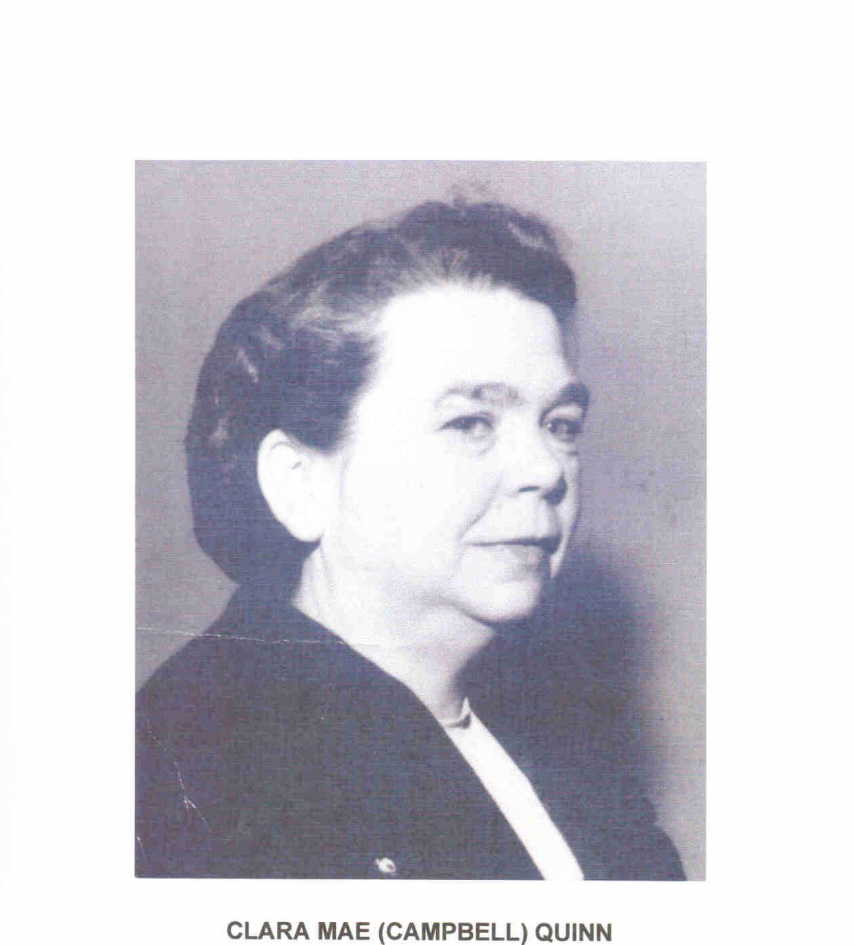
Ever since I first began my genealogy research in 2010, I have felt that a huge part of my heritage was missing. I was very upset to learn from my family that my great-grandmother, who grew up as Clara May Campbell and married James Abram "Garfield" Quinn, was not a Campbell at all. I heard many contrasting stories from several family members: that she had no idea who her father was, that her father could have been a male family member of her mother's, and finally that her father might have been named Schofield.

Most of the official records that genealogists usually look at were dead ends for me. Clara had a delayed certificate of birth, with only the most tenuous documents used as "proof" of the information's validity: the affidavit of a non-relative, the birth certificate of one of Clara's children, and a life insurance policy. It is very surprising that the delayed certificate was issued, considering that the information on these documents had to come from Clara herself.

Clara, somewhere around middle age. Circa 1950-1960.
I found the mostly the same information on other documents: marriage records, census records, and social security records all said that her name was Campbell. The only document that seemed to reflect any kind of corroboration with the old family story that she wasn't William Campbell's daughter was an application for social security benefits from the 1950s; the document listed her birthplace as Denver, Colorado.

With a bit of searching, I was able to find a multitude of information about the family of Clara's mother, Mary Ellen Walter. Most of the lines in that family had already been well-researched and thoroughly documented, with most being traced back to at least early colonial times. Mary Ellen's family had resided in Ohio for several generations by the time of Clara's birth. So why had she been born in Colorado, of all places? Mary Ellen had no family there. The common denominator had to be Clara's father. And so I wrote to the Colorado Division of Vital Statistics and explained the situation to them: I gave them Clara's birthdate, location of birth, and several last names to search for (Walter, Campbell, Schofield, etc.). After several long weeks of waiting, I received a reply. Their search had turned up no results.

Up until this point I had avoided using family tree sites to assist me in my work. I didn't want to be considered one of those "internet genealogists" who take everything they read on Ancestry.com for granted. But I finally caved and bought a subscription to Ancestry, in the hopes that it would provide me with records that I couldn't find elsewhere. 

Clara "Campbell"'s delayed certificate of birth.
The Ancestry subscription paid off. I was able to find a few records that I hadn't found before, including a census record from 1910. In 1910 Clara was about three and a half years old and was living in Trimble, Athens Co., OH with her grandfather, Amzi Walter, Amzi's "nephew," William Campbell, her mother, Mary Ellen, and her infant brother, Harvey. But here was a new development: Mary Ellen, Clara, and Harvey were all listed with the surname of Abbott, and Mary Ellen was listed as a widow.

I knew good and well that William Campbell wasn't Amzi Walter's nephew, because I knew that he would go on to marry Mary Ellen. I also had strong suspicions that the name Abbott was an alias and that she had never been married at all, but in the spirit of being thorough I did a national search for marriage records including brides with the surname of Walter and grooms with the surname of Abbott. I found several, but none of them pertained to Mary Ellen. Another dead end.

Mary Ellen Walter, mother of Clara May "Campbell"
At this point, I knew that record-keeping wasn't going to be what solved this mystery. If it had any hope of being solved, science was going to have to solve it. So in February of 2017 I had my DNA tested through Ancestry.com, thinking that I might be able to use the cousin matches to find a common match. When I got my results back, the number of matches was staggering. I had more than 650 PAGES of results - thousands of matches. I knew that I would probably be looking for at least a third cousin match, but I didn't count on the shockingly high number of people who have their DNA tested and then never create a family tree to go along with it. I did have several matches with the names Schofield and Abbott in their trees, but neither are uncommon names; many of the matches had only very small trees with minimal information, or were related to me in other ways and just so happened to also have the names Schofield or Abbott in their tree. It was beginning to look like another dead end.

I had the idea that if I could persuade one of Clara's two remaining children to take the test, perhaps we could get a closer and more definitive match. I asked them both, and they both refused. "But this man was your grandfather!" I protested. "Don't you want to know who he was?" But not everyone shares my obsession with their roots, and so this route was yet another dead end.

After this disappointing turn, I began to look at other options. I searched for people who were showing as 3rd-4th cousin matches who had names completely foreign to me in their trees. I found several of these, and began to reach out. I found many who were willing to help in any way they could, and a few who didn't appreciate me implying that one of their more recent ancestors had an illegitimate child. But ultimately I never got anywhere with any of these matches either.

While all this was going on I kept an eye on my matches, which continued to steadily grow. I discovered that two of my second cousins - who are great-grandchildren of Clara, just like I am - had also taken the test. I also had both of my parents tested when Ancestry happened to be having a sale on them, and was pleasantly surprised when their results were back in less than a month (I waited well over two months for mine). Naturally, I began looking through the results right away.

My mother, myself, and my second cousins, all
grandchildren of Clara, matched this DNA profile.
Just earlier this week, I finally had the break that I had been hoping for. I did another search for matches with the surname of Schofield in their trees, but this time from my mother's DNA matches. And lo! I found one: showing up as a third cousin match was a man named Robert, who matched my mother, myself, and both of my second cousins.

In looking at Robert's tree, there were two people who were within the age range to be Clara's father: Robert's grandfather, Joseph Schofield, and Joseph's brother, James. I immediately reached out to him and explained the situation, and he responded promptly. Among other family details, he told me that his grandfather had lived an interesting life, traveling in the rodeo circuit.

That bit of information got me thinking - a traveling rodeo might well be the missing link between a man from the Pacific coast and a woman from Ohio, who gave birth to a child in Colorado. I knew from a city directory record that Mary Ellen's family was living in Zanesville, OH at the time when she would have become pregnant with Clara. So I began to search for newspaper records of rodeo shows being in the area at the time, and sure enough: Pawnee Bill's Wild West Show was wintering in the neighboring county of Noble Co., OH beginning in November of 1905. They would have been there until at least March or so, and undoubtedly the many people who traveled with them would have made trips to the neighboring city of Zanesville. They also came back to Zanesville in September of 1906, less than a month before Clara was born. 

From the Zanesville Time Recorder, Friday,
November 17, 1905
From the Zanesville Times Recorder,
Friday, September 14, 1906
Mary Ellen undoubtedly met and entered into a relationship with Joseph Schofield while he was wintering in Ohio with Pawnee Bill's Wild West Show, and at some point she went back West with him and made it as far as Colorado. Whether she went before or after the September performance in Zanesville is unclear. We have no records of them between Clara's birth on October 1, 1906 and the 1910 census, but at some point during that time they must have broken up. Mary Ellen and Clara returned to Ohio, and by 1910 Mary Ellen was in a relationship with William Campbell and had born their first child, Harvey.

Joseph Schofield and his first wife,
Mary Madden.
After seven long years of searching, after repeated hopes and disappointments, there it was, laid out "in black and white," as the old newspaper saying goes. My head was spinning. A quick look at trees of shared DNA matches on Ancestry turned up a photo of Joseph Schofield (from his marriage to his first wife, six years after Clara's birth) and a photo of Joseph's parents, George and Mary Dotson Schofield. I couldn't believe that I was finally looking on the face of the man that I had searched for for so long, that I was beginning to think that I would never find. I posted the photo to my Facebook page with a brief explanation of who he was, and family members immediately began commenting and saying how he resembled Clara's children. Several of them messaged me, asking how I found him and for more information.

    Joseph's Parents, George Schofield and
Mary Dotson.
I am still piecing together details of Joseph's life, but I believe that it is safe to say that all of the circumstantial and DNA evidence has proved beyond reasonable doubt that Joseph Schofield was Clara's father. The 5-way DNA match is undeniable; the information that Clara's family members gave about her believing her father's name to be Schofield, Robert's information about his grandfather being in a rodeo, and the newspaper articles about a rodeo being near Mary Ellen's hometown at the right times all support and corroborate with the DNA evidence. Ancestry mistakenly included Robert in my mother's 3rd cousin matches because Robert's mother and Mom's grandmother were half-sisters instead of full siblings, making their number of shared DNA segments smaller. So instead of being third cousins, they are actually first cousins once removed (meaning that Robert and Mom's father are first cousins).

We look forward to learning about the newest branch of the family tree, and to getting to know our new cousins. I am forever grateful to them for their cooperation and the information that they provided.

So the great 116-year-old mystery is solved. What next? I need a new ancestor to find....


Wednesday, July 5, 2017

Genealogy Research: A Quick-Start Guide

Last year I composed a short quick-start guide for genealogy beginners, which I posted on my personal Facebook page. It was designed to help the average person with little to no research experience get started on their family tree, without having to pay for a service like Ancestry.com or MyHeritage.com (which are wonderful sites, but should not be relied upon exclusively). Below is the post in full, with a couple of added strategies that I've learned since.

"As many of you know, I am very passionate about genealogy research and devote quite a bit of any spare time I might have to it. Several people have asked me how to get started, what methods I use to search for information, and which sources are the most reliable. I thought I would take this opportunity to compose a short guide for those who want to get started, or to give some fresh ideas/resources to those who have been doing this for awhile.

  1. Your first, best source of information are your living relatives, especially those who are elderly. Your grandparents will usually at least know the names of their grandparents, and maybe their great-grandparents if you are lucky. They will also usually be able to tell you what general area their ancestors immigrated from, or whether they were Native American. (Native American ancestry has its own challenges. More on this later.)
  2. Those whose immediate ancestors are from West Virginia have an amazing resource available to them: the West Virginia Vital Records Research Database. This database has birth, death, and marriage records prior to about 1955 in most counties, although the availability is different in each county due to courthouse fires, floods, etc.
    1. Beware of alternative spellings on these records, or even closely-related names. For instance, the names Kessinger and Kissinger seem to have been interchangeable in records relating to my family. Names like Mary and Molly, Betty, Betsy, and Bessie, etc. are also often used interchangeably. Remember that many of the people that these records pertain to were illiterate, and they were dependent on other people to write for them.
    2. Death records are the best source of information in this database. In addition to the name and date of death of the person in question, death records will usually tell you their birth date, place of birth, place of burial, and the names of the person's parents.
    3. West Virginians are extremely lucky to have this resource available to them for free! Not many states offer such a database, and those that do often charge for its use.
  3. If you cannot find any records pertaining to your ancestors in the database above or one similar, census records will be your best friend. All census records from 1940 and before are available for search. The best search tool I have used for census records is FamilySearch. It will allow you to search by name, birthplace, residence place, and by relation to another person.
  4. Once you know the names of your great-grandparents or perhaps your great-great-grandparents, start searching their names together in Google and see what comes up. When I do this, I usually enter the search term like this (using the names of two of my great-grandparents as examples): "Clifton Kessinger Ella May Lovejoy West Virginia." If you are lucky, as I have often been, someone has already done a lot of the work for you from here on out. You can often find genealogy reports that have been posted online by one of your distant relatives that will sometimes go back hundreds of years.
    1. While this is extremely convenient when it happens, DO NOT automatically take such things at face value, especially if the information is posted to a website without any supporting information/documentation or with only very vague information. Try to do a little more research and confirm the connections if you can.
    2. If you are not lucky and no one has done this kind of work on your family yet, don't despair! Try to go back a couple more generations, then try again. Chances are, you will eventually hit this kind of information if you go back far enough.
  5. Google Books is also an amazing resource for discovering long-reaching records of family lines. This resource is especially helpful if you can prove that you are descended from a noble family, particularly those from the UK, France, and Germany. Most people would be surprised to learn that they probably have several noble lines in their family trees. This is actually quite common; the earliest American immigrants from Europe were often second-sons (i.e. those who did not inherit the family fortune and titles) and daughters of noblemen who came here because there was much more potential for land ownership, positions of power, etc. than what was available to them in Europe. 
    1. These are often called "gateway ancestors" because once you prove descent from them, it opens up a huge amount of record availability. English nobility and gentry were especially good keepers of records.
  6. There are several online resources that I use often. These include, but are not limited to:
    1. Daughters of the American Revolution databases
    2. Find My Past (especially good for UK records)
    3. RootsWeb (more reliable than other sites because it relies heavily on hands-on research that has been uploaded via GEDCOMs)
    4. FindAGrave (a great resource for cemetery info, as well as providing some genealogy info)
  7. Native American Ancestry, as I said before, is especially challenging. The Removal Act of 1835 made it illegal to be Native American and live east of the Mississippi River, so many went into hiding to avoid being relocated. I recommend the book "My Family Tells This Story" by Snow Flower if you are interested in learning how to search for Native American ancestry.
  8. Ancestry.com offers some great forms that can help you keep track of your information. I highly recommend using each of these forms and keeping very careful records of your work.
  9. Lastly, it is important to remember that the Internet cannot give you all information that you will be looking for, particularly if you know that you have Native American ancestry. You will need to go to your state archives collection and look for deeds, wills, legal documents, old newspapers, etc. to get primary source documents for your information. State archive collections usually have at least one expert in genealogy research who can help you find what you are looking for. Cemeteries are also a great source of information, particularly small family plots and historic cemeteries.
Please note that this is by no means a comprehensive list! These are just the resources and methods that have worked best for me. I have often had to get very creative to find information on certain lines. Please let me know if you have any questions, or if I can help you get started with your search!"

Welcome!

Welcome to Rooted Heritage Genealogy! This blog is dedicated to both telling my ancestors' stories and to helping others to do the sam...