Thursday, July 5, 2057

Welcome!

Welcome to Rooted Heritage Genealogy! This blog is dedicated to both telling my ancestors' stories and to helping others to do the same for their own ancestors.

Please feel free to use any photos, documents, or information that you find here. However, please remember that I put a lot of time and effort into this research, so giving me credit for my work is always appreciated.

If you would like help with an ancestor that is giving you trouble, please feel free to contact me and I will do my best to help set you in the right direction. We all have our "brick walls," so I know all too well how much even the smallest clue can help in breaking them down.

Be sure to like Rooted Heritage Genealogy on Facebook, and to become of member of our related Facebook Group, Genetic Genealogy. You can also find RHG on Instagram, @RootedHeritage.

Happy searching!

- AQK

***

RHG is doing 52 Ancestors in 52 Weeks in 2022! Click here to see the master post.

Thursday, December 29, 2022

Follow-Up: Ka-Okee, Daughter of Pocahontas

I have received many comments and emails of late regarding my original post about the theory of Ka-Okee being the daughter of Pocahontas and Kokoum, so I felt that the time was right to do a follow-up post that addresses some of the more popular questions and comments that I have received, as well as providing some more context and information that I have obtained through research and correspondence with William Deyo, historian emeritus of the Patawomeck Tribe of Virginia. In order to be as clear and concise as possible, this post will be divided into sections, each addressing a different issue.


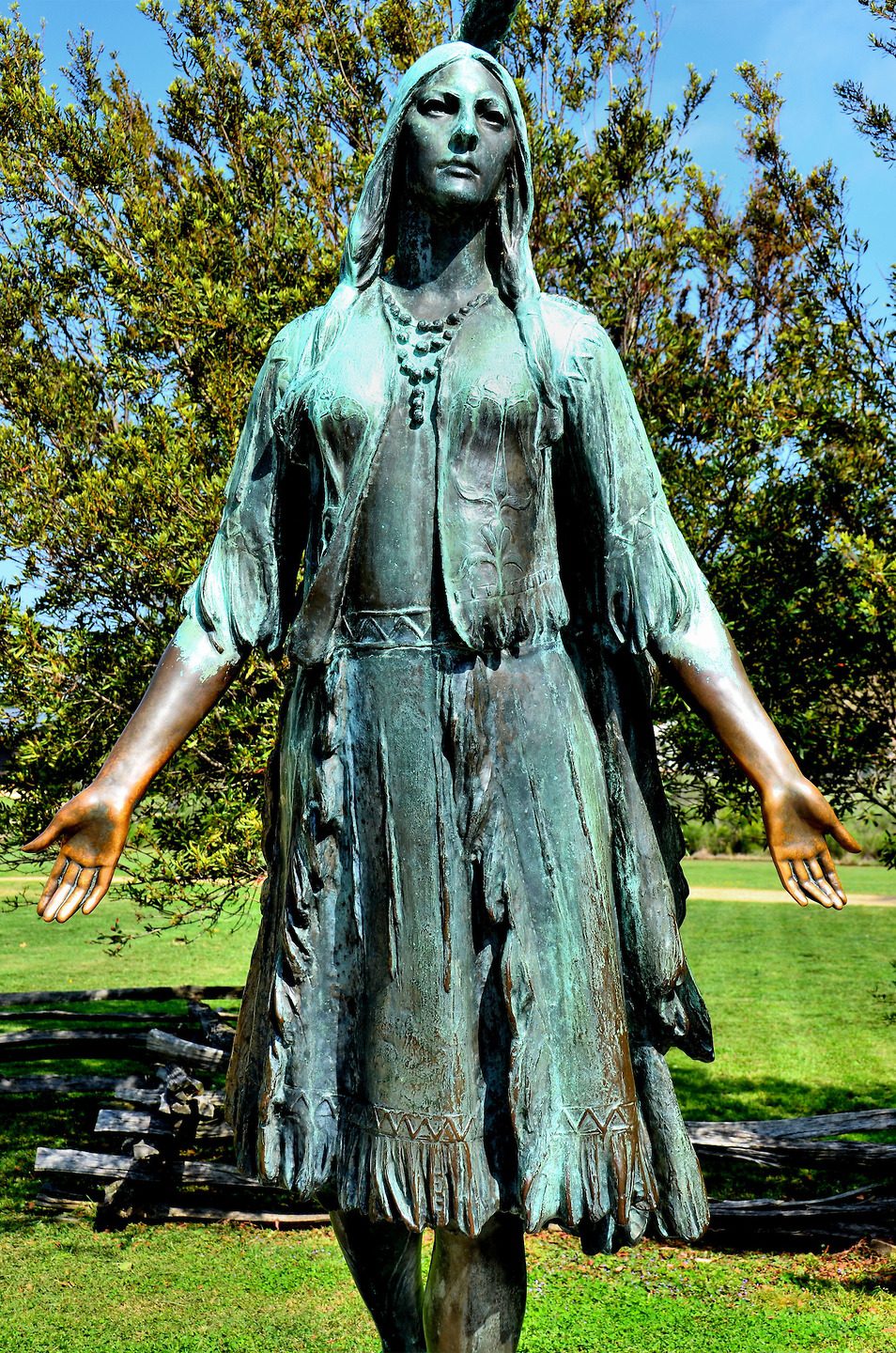
This bronze statue of Pocahontas, completed in 1913, 
is one of the most famous landmarks of Jamestown Island.


There is strong evidence that a Native American woman named Ka-Okee existed and is the ancestor of many current members of the Patawomeck Tribe, even if she was not the daughter of Pocahontas and Kokoum.

Many members of the Patawomeck tribe have long known that they were descended from an early colonial Patawomeck ancestor named Ka-Okee. This knowledge was made apparent by Ka-Okee's many namesakes. Several of her descendants were named after her, including Kaokie Chilton (1849-1924), oldest daughter of William Chilton and Susan Robertson; and Golden Okie Rose (1905-1985), youngest daughter of Henry Rose and Eliza Robertson. A quick records search on Ancestry.com for the name "Okie" and related spellings will show you records pertaining to at least a dozen other people from Stafford County, VA (ancestral home of the Patawomeck Tribe, and home of their tribal center today) who also carried this name in one variant or another. It has long been asserted by many tribal members over several generations that Ka-Okee was the mother of Christian Martin (born c. 1637), wife of John Martin of Stafford County.

Kaokie Chilton and Golden Okie Rose were relatives of William Deyo. Kaokie Chilton died before he was born, but he knew Golden Okie Rose - and she was the one who told him that she and her cousin, Kaokie Chilton, were named for their ancestor. During our correspondence, he told me the following:  "When I was a teenager, I went with my grandaunt and grandmother to visit their cousin, Okie, and asked her about her name.  Okie told me that her mother (Eliza) wanted to name her after her ancestor, Pocahontas, but her husband (Henry Rose) would not allow her to do it.  He did allow her, however, to name the daughter, "Golden Okie", after another Indian ancestor." 


Detail from the 1880 US Census, showing Kaokie Chilton in the household of William Chilton.

While the preservation of this unusual name is not in and of itself proof of Ka-Okee's existence and lineage, the fact that two people within the same family carried such an unusual name and were both said to have been named for the same ancestor is compelling circumstantial evidence for the existence of that ancestor. Add to it the many other people from the same area, most from connected families, who have variants of the same unusual name, and the evidence becomes even more compelling.


The theory of Ka-Okee being the daughter of Pocahontas did not come about until William Deyo started connecting the dots.

Oral histories are much stronger among families of Native American descent who remain in touch with their ancestral practices. As a result, these families are often able to retain accurate information about their past over the course of many generations - far better than the typical family of European descent. Deyo knew of many families belonging to the Patawomeck tribe who were adamant about their family's descent from Pocahontas; however, none of them could find a genealogical connection to Thomas Rolfe, Pocahontas' only documented child. Deyo's family was one of these, and in an effort to find their connection to Pocahontas, he began tracing the genealogies of many of Stafford County's most prominent families. 

After many years of research, he never found a common connection between these families and Thomas Rolfe. What he did find, however, was that every one of these families did descend from Christian Martin, either through her first marriage to John Martin or through her second marriage to Francis Waddington. This is when he began to theorize that not only must Pocahontas have had a second child, but that Ka-Okee could possibly be this child. He knew that Christian Martin Waddington was born about 1637 (she had said during a deposition in 1687 that she was about 50 years old), which meant that her mother would have been the right age to be Pocahontas' child.


William Deyo formed his theory about Pocahontas having another child and about Ka-Okee being that child long before the book The True Story of Pocahontas: The Other Side of History by Custalow and Daniel was published.

Deyo's theory regarding Ka-Okee was already fairly well-formed before the chief of the Mattaponi Tribe, Dr. Linwood Custalow, worked with anthropologist Angela Daniel to publish the portion of the Mattaponi Sacred Oral History that pertained to Pocahontas. Pocahontas' mother, for whom her daughter was named when she came of age, was a member of the Mattaponi tribe and was the favored wife of Chief Wahunsenacawh (known more commonly by the name of his tribe, Powhatan). Because of this connection, the truth about Pocahontas' early life, her first marriage to the Patawomeck warrior Kokoum (which was also recorded by William Strachey, a member of the Virginia Company, in 1612), her involvement in Native American/English relations, her kidnapping and captivity at the hands of Samuel Argall, the abuse and rape she suffered while being held hostage, her forced marriage to John Rolfe, and her suspicious death while en route back to Virginia from England were preserved via oral histories, carefully passed from one generation to the next over the course of four centuries. 

When Deyo happened across the book and found that the Mattaponi had preserved the fact that Pocahontas had another child from her marriage to Kokoum, it confirmed the first part of his theory: Pocahontas did have another child. The book referred to the child as "Little Kokoum," but an appendix explained that as the child was raised by the Patawomeck after being orphaned, the Mattaponi did not not actually know much about the child other than the fact that a child existed. "Little Kokoum" was the name that Custalow and Daniel used to refer to the child; but the fact of the matter is that the Mattaponi did not even know whether the child was a son or a daughter.

Considering the fact that neither tribe remembered the name of the child, it actually makes much more sense that the child was a daughter. It would have been far more acceptable for an English man of means (such as Thomas Pettus, who many genealogists agree is the most likely candidate for the father of Christian Martin Waddington) to marry a Native American woman of prominent parentage than for an English woman to marry a Native American man, especially if the English man of means could gain control of large tracks of desirable land as a result.


"There is no written record of Ka-Okee, her parentage, or her marriage and progeny."

No - there's no surviving record that directly references Ka-Okee, her parentage, or her marriage and progeny. 

According to Patawomeck tradition, Christian Martin Waddington was the daughter of a prominent English colonist and Ka-Okee, who even before the Pocahontas theory emerged was known to be from a prominent family of the Powhatan confederation. Many genealogists agree that Thomas Pettus is the most likely candidate for Christian's father, among them William W. Pettus IV, who published three volumes on the subject of Pettus genealogy. In his last book, Foundations of Pettus Family Genealogy in Virginia, Pettus examined the "Pocahontas Connection" carefully, using both the oral traditions of the Mattaponi and Patawomeck and the few primary source documents that were available regarding Thomas Pettus. He found that Thomas Pettus obtained 1,000 acres of very desirable land along Potomac Creek, which directly adjoined the land where the seat of the Patawomeck tribe was located. This suggests that there was a strong connection between Thomas Pettus and the Patawomeck tribe. You can read more about this matter at the Pettus Heritage blog, which was founded by William Pettus before his passing in 2021.

Countless records from Colonial Virginia were destroyed by fire, flood, and shear unadulterated carelessness over the centuries. There might well have once been a record of a marriage between Thomas Pettus and Ka-Okee, which could have been subsequently destroyed or otherwise lost. It's also a possibility that they were never married at all, but still had a child together. He certainly would not have been the first man to sire a child out of wedlock, provide for the child, and later secure a good marriage for said child. 

As to the matter of a written record of Ka-Okee's parentage: there wouldn't be one. The Patawomeck undoubtedly wished to protect the child's identity, out of fear that the child would be kidnaped and held for ransom, as Pocahontas was. 


"The True Story of Pocahontas: The Other Side of History is a hoax. These events happened in the way that the English recorded them."

Claims like this are frankly quite problematic and insensitive. What right do people of European descent have to claim that they are more knowledgeable about this history of a tribe than the tribal members themselves? And aside from the fact that calling the authenticity of the sacred oral history of the Mattaponi into question is wildly racist, consider this: they have no reason to lie about this. They have nothing to gain. And as I pointed out in my previous post, this project was originally a PhD dissertation from the College of William and Mary, an Ivy League university, which would have gone through a rigorous process of review by experts in the field. If they find the Mattaponi's sacred oral history to be credible, we can as well.


"Everyone wants to be connected to Pocahontas. This story is just a desperate attempt to make that claim."

Here's the thing: claiming descent from a prominent historical figure is only a point of pride for the one claiming it if a) it's true and b) you can prove it, or at least make a solid case for it. Most people who have done solid research on this topic would of course be disappointed if some sort of primary source evidence could prove that the claim was unequivocally untrue; however, I doubt that a single one of them would continue to make the claim if confronted with this hypothetical evidence. Genealogy is a science, and as such we follow the evidence. And while we will never know the full story of Ka-Okee, the evidence suggests that she existed, she was a Patawomeck woman of some prominence, and she married a prominent English colonist and had issue. There is further evidence to suggest that she was strongly connected to Pocahontas, and that the man she married was Thomas Pettus. 

It is worth mentioning here that several people who read my original post and contacted me have said that long before they ever heard of William Deyo and his theory, their relatives passed the story of Ka-Okee and her connection to Pocahontas on them, but that they were told that Ka-Okee was actually Pocahontas' sister, not her daughter. This is also a strong possibility, and one that will need to be investigated further.

One commenter from the original post posed this question:

If there was no documented proof that Ka-Okee existed or who she married, then why assume it must be so? A lot of families wanted to be related to Pocahontas, and have assumed it to be fact. And why is Pocahontas more important than any other Indian?

I believe that people seek to find a genealogical connection to her not only because of her extraordinary story, but because she is one of the few Native Americans that history remembers by name. For every Pocahontas, Zitkala-Sa, or Susan LaFlesche Picotte, there are literally millions of Native American women whose names were never recorded on paper, and unfortunately go unremembered today. It's only natural that so many people want to have a genealogical connection to her - but only if it's a real genealogical connection.


When considered in context, there is a possibility that Pocahontas herself left us a clue about her first child in her final words.

Detail of the statue of Pocahontas at her burial site in Gravesend, Kent, United Kingdom.

As a fitting ending to this follow-up post, I will leave you with Pocahontas' last words, and how their meaning might go deeper when considered in context of the Mattaponi's sacred oral history. According to her second husband, John Rolfe, Pocahontas' last words before she passed away from a sudden illness were: 

"All must die. ‘Tis enough that the child liveth."

On the surface, most would assume that she was speaking about her son, Thomas Rolfe. However, when you consider the bleak reality described in the Mattaponi's sacred oral history, these words take on another meaning. According the oral history, Pocahontas left her firstborn child with relatives before she was lured aboard an English ship, captured, and held for ransom by Samuel Argall. The oral history goes on to say that during her captivity she had to endure the murder of her first husband Kokoum, forced assimilation into English culture, and horrific sexual abuse. After ten months of captivity, Pocahontas finally agreed to convert to Christianity, take the Christian name of Rebecca, and marry John Rolfe in order to improve not only her own living conditions, but to reestablish peace between the English and the Powhatan Confederation. It is unclear whether the English were aware of her first child, but my guess is that they were not; otherwise, the child might have been found and held for ransom like Pocahontas was.

Could it be that Pocahontas' last words before her untimely (and, frankly, suspicious) death were actually one final act of defiance? Was she actually saying "You may have killed me, but my first child - the child not of one of my captors and abusers, but of the man I married for love - lives on among her own people"?

We will never know for certain whether this was the case, but like the other evidence presented here, it is quite compelling when examined in context.

Sunday, January 2, 2022

2022 #52Ancestors Challenge: Week 1: "Foundations" - The Home of Zack and Madge Hunt

When I first looked at the themes for this year's 52 Ancestors in 52 Weeks challenge, I wracked my brain for an a suitable "Foundations" story. I bounced a few ideas around that involved more distant ancestors, but then I suddenly remembered that the best "foundation" story in my family was actually very close to me: the story of the foundation of my great-grandparents' home.

I am often guilty of forgetting the fact that places matter just as much as people when it comes to genealogy, but that fact is never so true as in the case of a beloved family home. 163 Maple Road, Belle, WV was home to many people over the years, but it started its life as a small "honeymoon cottage." Sometime during the winter of 1939, Ernest Zacharias "Zack" Hunt proposed to Madeline Eva "Madge" Moore. To his delight, she said yes! When he asked her when she wanted the wedding to be, she said "Oh, how about the 4th of July?" because to her "it sounded like a long way away."

163 Maple Road, circa 1942
I remember the day that Mamaw Madge and Papaw Zack told this story to me and my mother. It was a warm Summer day, and we were sitting at a little swing and picnic table area in their front yard. When Mamaw laughed about thinking that the 4th of July sounded like a long way away to her when Papaw proposed, Papaw said "Yeah, she was thinking about making the wedding a long way away... Meanwhile, I went home that very day and started building a house. I didn't get it finished by the 4th of July, but I did the best I could." And so that very day, the foundations of their family home were laid. They went on to share that home for nearly 70 years.

It wasn't long after the 4th of July that they got married. On September 20, 1940, Mamaw Madge told her mother and father that she was going to spend the weekend at her brother's house. That was not her destination, however - instead she traveled to Catlettsburg, TN with Papaw Zack; his father, Andrew; his sister, Margaret; and Margaret's young son, Roy. They were married by a justice of the peace on September 21, 1940, with Andrew and Margaret as witnesses. Mamaw later laughed about the fact that on both the journey and the return journey the next day, Papaw and his father sat in the front seat of the car while Mamaw, Margaret, and Roy sat in the back seat.

163 Maple Road, circa 1965. Two ground-floor rooms and two upstairs rooms had been added.
When they went back to Mamaw's family home to tell her parents that they were married, Mamaw's mother burst into tears and said "who's going to milk the cow?" Mamaw's father wasn't terribly happy about the union either, as he thought that Papaw wasn't a good enough match for her. Fathers frequently think this about their daughters' husbands, but Grandpa Moore didn't approve of the fact that Papaw Zack's parents were divorced. I can only assume that they both got over it, however, since by all accounts they grew to love Papaw very much.

The honeymoon cottage that Papaw built became the home that they lived in their entire lives. Over the years it was home not only to them and their children, but also to their grandchildren, brothers and sisters, nieces and nephews, and many others who stayed under its roof at one time or another. 

163 Maple Road, as it looks today.
The house underwent several renovations and additions throughout its life. It started out as two rooms: bedroom/living area and kitchen. A few years later four additional rooms were built: a bathroom and a bedroom on the ground floor, and two small upstairs bedrooms. During this time many other improvements were also made, including indoor plumbing and electricity. The house stayed like this for many years until the 1980s, when a large master bedroom and additional bathroom were built on. Seeing its transformation from small, simple two-room cottage into the picturesque little house it became always makes me smile. It was the culmination of a lifetime's work.

As is often the case when the progenitors of a family pass away, the house was sold after Mamaw's passing in 2017 (Papaw had preceded her nearly 9 years before). I never met the family that bought the house, but I hope that it brings them as much joy and happiness as it brought to our family. 

***

Saturday, January 1, 2022

Master Post: 52 Ancestors in 52 Weeks 2022

 It's that time of year again, folks! After only having one significant blog post in 2021, I'm ready to get over my general burnout on life and give this challenge another go. I have yet to ever finish one of these, but who knows: maybe 2022 will be my year!

As usual, this post will be a "master post" with direct links to all of this year's themed posts. The themes for this year also have an over-arching monthly them, so if I cannot do a post every week, I will do my best to at least do a monthly post.

***

January – Foundations
Week 1 (Jan. 1-10): Foundations - The home of Zack and Madge Hunt
Week 2 (Jan. 11-17): Favorite Find
Week 3 (Jan. 18-24): Favorite Photo
Week 4 (Jan. 25-31): Curious

February – Branching Out
Week 5 (Feb. 1-7): Branching Out
Week 6 (Feb. 8-14): Maps
Week 7 (Feb. 15-21): Landed
Week 8 (Feb. 22-28): Courting

March – Females
Week 9 (Mar. 1-7): Females
Week 10 (Mar. 8-14): Worship
Week 11 (Mar. 15-21): Flowers
Week 12 (Mar. 22-28): Joined Together
Week 13 (Mar. 29-Apr. 4): Sisters

April – Check It Out
Week 14 (Apr. 5-11): Check It Out
Week 15 (Apr. 12-18): How do you spell that?
Week 16 (Apr. 19-25): Negatives
Week 17 (Apr. 26-May 2): Document

May – Social
Week 18 (May 3-9): Social
Week 19 (May 10-16): Food & Drink
Week 20 (May 17-23): Textile
Week 21 (May 24-30): Yearbook

June – Conflict
Week 22 (May 31-June 6): Conflict
Week 23 (June 7-13): Mistake
Week 24 (June 14-20): Popular Name
Week 25 (June 21-27): Broken Branch

July – Identity
Week 26 (June 28-July 4): Identity
Week 27 (July 5-11): Extended Family
Week 28 (July 12-18): Characters
Week 29 (July 19-25): Fun Facts
Week 30 (July 26-Aug. 1): Teams

August – Help
Week 31 (Aug. 2-8): Help
Week 32 (Aug. 9-15): At the Library
Week 33 (Aug. 16-22): Service
Week 34 (Aug. 23-29): Timeline
Week 35 (Aug. 30-Sept. 5): Free Space

September – Exploration
Week 36 (Sept. 6-12): Exploration
Week 37 (Sept. 13-19): High and Low
Week 38 (Sept. 20-26): New to You
Week 39 (Sept. 27-Oct. 3): Road Trip

October – Preservation
Week 40 (Oct. 4-10): Preservation
Week 41 (Oct. 11-17): Passed Down
Week 42 (Oct. 18-24): Lost
Week 43 (Oct. 25-31): Organized

November – Shadows
Week 44 (Nov. 1-7): Shadows
Week 45 (Nov. 8-14): Ghost Story
Week 46 (Nov. 15-21): Tombstones
Week 47 (Nov. 22-28): Wrong Side of the Law
Week 48 (Nov. 29-Dec. 5): Overlooked

December – New Horizons
Week 49 (Dec. 6-12): New Horizons
Week 50 (Dec. 13-19): Traditions
Week 51 (Dec. 20-26): Perseverance
Week 52 (Dec. 27-Jan. 2): Looking Ahead

Friday, October 22, 2021

Genealogy Burnout: A COVID Side-Effect


Whenever I begin a blog post, it usually takes several days of research, drafting, and editing before the final product is published. I was fortunate to have the opportunity to study research methods for two semesters during both undergrad and graduate school, so the research and source documentation process is so engrained in me that I have to take the time to do it right. But this post is going to be different in that it will be more candid, not heavily researched, and not about an ancestor. So with that said: let's talk genealogy burnout.

Unless you've been living under a rock for the past year and half, you know that we are in the midst of the first global pandemic in over a century. Our entire lives were turned upside down overnight, and what we thought would be temporary changes lasting for a month or so at most have been our "new normal" for the past 19 months. And while physical health has been at the forefront of our thoughts during this time, the affects of our mental health as a result of Living in a prolonged state of uncertainty and fear need to be addressed.

If you were anything like me during the first few weeks of quarantine you might have, in your heart of hearts, been secretly glad for the break in life's grueling pace. Sure, staying home all the time, adjusting to working from home, not seeing friends and family in person, and wearing a mask on those preciously rare trips out in public to the grocery store was a pain, to say the very least. But on the other hand, for many of us, this quarantine was the first time that we truly had the time and energy to explore activities that we actually enjoy doing. During those early weeks I took up drawing and painting again, I practiced the flute pieces that had been on my "to play" list for years, and of course I did a lot of genealogy research and wrote several blog posts.

However, as weeks turned into months, the gravity of the situation started to weigh on me. In the beginning COVID was something vague and far-away, something that happened to "other people" and "other people's families." But as time went on and people that I knew people contracted the disease (and unfortunately some of those people did pass away as a result), I started to slip into a depression and to lose interest in the activities that I had thrown myself into a couple months before. 

This depression got even worse when I went back to working in-person after five months of working from home. At the beginning of the pandemic I was a middle school choir director, but due to staff reduction at my school I was transferred into an itinerant elementary general music position. The country entered into quarantine while my district was on Spring break, so what we all thought was going to be a week-long vacation turned into me never getting to say goodbye to my beloved choir students, and my students never getting to perform the musical and Spring concert that they had worked so hard on. During this time I prepared my lessons at home, and only went into the school once per week to prepare take-home packets for students without internet access. I had just begun to get over this sense of loss when we went back to school in September. For over a month my entire district was on eLearning, so I sat in an empty classroom recording and editing lessons all day. (Teaching to a camera is hard, by the way. 0/10, do not recommend.) When we finally did resume in-person school, it was so drastically different that it really just made me more depressed than happy to be back with students. Not only was I adjusting to teaching music in a different way - I was also adjusting to teaching a very wide age range, from PreK - 5th grade. I had no dedicated space for teaching music because I had to travel classroom-to-classroom (to reduce traffic in the hallways), and I was not allowed to sing or use instruments with students during the first few months. We did a lot of body percussion, a lot of music history, a lot of iPad apps. The kids and I were both sick and tired of this after just a few weeks. I was also recording and posting lessons for eLearning kids in addition to teaching in-person kids, so I was feeling incredibly stressed and overwhelmed most of the time.

By the time 2021 rolled around, I was incredibly burnt out with everything. Almost all of my energy was consumed by my job, and by the time I got home all I wanted to do was lay in bed and watch Netflix. I didn't want to research or write genealogy blog posts, I didn't want to practice, or paint, or any of the things I had enjoyed during quarantine. I jotted down several ideas for posts, but for the past several months the mere thought of sitting down to focus on researching and writing a post seemed like such a grueling and daunting task.

Three weeks ago the thing that I had dreaded and dodged for a year and a half finally happened: I contracted COVID, as did my father. Thankfully, my mother did not contract it. Neither of us had to be hospitalized, but I was sicker than I had been in a very long time. It felt like having a very bad case of the flu and bad allergies at the same time. I lost my senses of taste and smell, I had runny nose and watery eyes that about drove me crazy, my fever would spike at seemingly random intervals, and I had fatigue like I had never felt in my life. A round of steroids helped, but even with them it was absolutely miserable. (So let this be a lesson to you: wear your mask, wash your hands, AND GET YOUR VACCINE!) Needless to say, getting COVID definitely didn't help the funk that I was in. But now that I am finally able to come home from work and NOT sleep for several hours (most days), I am trying to pull myself out of it by engaging in the things that I enjoy - and of course, genealogy is at the top of that list.

I'm trying to get myself motivated to do this by getting some of these thoughts down and sharing them with other genealogists. Have you experienced genealogy burnout? Has your mental health been affected by the pandemic? Or were you able to focus and get a lot accomplished during this time?

Also, please let me know if there are any certain topics you would like to read about! I have a few in mind at the moment, including one that I am currently researching that is kind of genealogy-adjacent. Expect that post soon! (No seriously: hold me to that, lol.)

I hope that this post finds you all well, and that you are finding ways to keep yourself sane during this crazy time. Happy ancestor hunting!


Saturday, April 3, 2021

Ten Tips and Tricks for Breaking Down Brick Walls


Hello again, everyone! For our first post of 2021, I decided to reach out to the Genealogy! Just Ask! community on Facebook and ask what topics they would like to see covered. One of the most requested topics was "tips for solving brick walls," and to be honest I was a little hesitant to take it on. It's been covered in other blogs, and by some that are much more experienced than me. But then I remembered the reasoning behind one of my tips: sometimes, all you need is a fresh set of eyes! I hope that this list will help someone send a wrecking ball right through their brick wall.

01. Reevaluate what you already have.

This might seem self-explanatory, but don't underestimate the power of taking another look at the records that you already have. In a previous blog post, I wrote about how I made the mistake of taking another researcher's work as fact; but when I took another look at the records, I found that I had the wrong parents attached to my great-great-grandmother. Sometimes a fresh perspective can help you find the details that you might have missed before. 

02. Check for related spellings of both first and last names.

If you have had little success using databases to find records pertaining to a specific ancestor, try searching for a different spelling. For instance, it took me a long time to find a death record for my great-great-grandfather because his last name was listed as "Kissinger" instead of "Kessinger." If you're not sure which spelling might have been used, most databases have an option to search for an "exact match" or to search for "exact and related" matches. 

03. Look for people with the same last name located in the same area in census records.

Even today, families tend to stay in the same general geographic areas. Searching census records for people of the same last name in the same location can give you a clue as to who possible relatives might be. I used this trick to find the parents of my 5th-great-grandmother, and was able to confirm my findings with genetic genealogy research (you can read about it at this post). My favorite site for this kind of search is Family Search, as you can search by name, location, and relation to another person.

04. Look for clues in the names of your ancestor's children.

Naming children after family members is a practice that many still use today, but a century ago it was very much the norm. For instance: if your brick wall ancestor has a child with an unusual name - particularly one that sounds more like a surname - there is a good chance that it is the maiden name of a mother or grandmother. For instance, my ancestors, Joseph Chew and Ruth Larkin, had a son named Larkin Chew.

People of Scotch-Irish descent had a specific pattern for naming their children that followed their family trees. The usual path of this pattern was:

The first son was named after the father’s father.
The second son after the mother’s father.
The third son after the father.
The first daughter after the mother’s mother.
The second daughter after the father’s mother.
The third daughter after the mother.

There are many examples of this pattern being followed in my own family tree. It is a good place to start when searching for the parents of a Scotch-Irish brick wall ancestor.

05. Use the triangulation method.

Sometimes you may not find a document that comes out and says "the parents of John Doe are James and Jane Doe," but you might be able to find pieces of information on several documents that make a compelling case for James and Jane being John Doe's parents. 

Here is an example from my own tree (more detailed information at this Find a Grave profile):

01.  In the 1850 Federal Census Josiah Moore, age 26, and his family are shown living next door to Joseph Moore, age 55, and his family. Joseph Moore's spouse, referred to as "H. Moore," lists her birthplace as Vermont.

02. In the 1900 Federal Census Josiah Moore is found living in Kanawha Co., WV with his second wife, Rebecca, and their children; he lists his mother's birthplace as "Vermont."

03.  In the book Historical Sketches of Pocahontas County, West Virginia by William Thomas Price, published in 1901, the author states that "Joseph Moore was a soldier in the war of 1812. During his service he met and married Hannah Cady ....Their family consisted of five daughters and three sons: Hannah, Sarah, Matilda, Margaret, Abigail, Daniel, Joseph, and Henry Harrison."

From these three sources, we can deduce that (1) Joseph Moore and Hannah Cady had a son that Historical Sketches lists as "Joseph," which is no doubt meant to be "Josiah"; (2) Josiah Moore at one time lived next door to Joseph and "H." Moore, who was from Vermont; (3) Josiah Moore stated in a later census record that his mother's birthplace was Vermont. Although none of these documents (nor any others, unfortunately) actually come out and say that Joseph and Hannah are Josiah's parents, the other information provided on these records proves beyond reasonable doubt that Josiah was their son.

06. Pension records can be a wealth of information.

For veterans of the Revolutionary and Civil wars especially, pension records can provide a wealth of information that might otherwise not have been recorded. Birth, marriage, and death records prior to 1900 were spotty to say the least, and were often the victims of floods and fires. 

The following is an excerpt from a previous blog post that I wrote regarding this topic:

"On several occasions between 1776 and 1867, Congress enacted legislation that allowed veterans, their widows, and their orphaned children to apply for government pensions in exchange for their (or their relative's) service during the Revolutionary War. Each act after 1776 expanded on the benefits received by the veterans and their families.

In order to establish that the people applying for the pensions truly were entitled to the pension benefits, they had to appear in court and give testimony about such details as when and where they served in the continental army, which company they were in, and who commanded it. Widows and children of the veterans had to provide additional information, such as the date and location of their marriage, the date and location of their spouse's death, and the date and location of their own births. Occasionally they would be required to bring witnesses to attest to these facts, and to provide additional evidence that they were who they said they were."

The Revolutionary War pension record of my 4th-great-grandfather, John Wright, told us in which company he served, his marriage date, the maiden name of his wife, his wife's father's name, the places of residence for John and his wife at the time of their marriage, John's date of death, his wife's date of death, the fact that his wife had a sister who married a Humphries, the fact that they had a son who died in the War of 1812, and the names and places of residence for all of their surviving children and their spouses. This kind of information would ordinarily take dozens of records to compile, if it even existed at all; but because John was entitled to a pension, it was all compiled into one place.

07. Branch out to people associated with your brick wall ancestor.

As mentioned above in the section on the triangulation method, you might not always find a record that comes out and says that "John Doe is the son of James and Jane Doe." However, you might know from a census record or an obituary that John Doe had a sister named Janet Doe, and Janet Doe might have a death record that lists the names of her parents. Branching out to people that you know were associated with your brick wall ancestor might just provide you with the wrecking ball you've been looking for.

08. Reach out to other researchers.

Sometimes a fresh set of eyes is all that is needed to bust through a brick wall. I searched for the parents of my 3rd-great-grandmother for many years with no luck, and at one point even came up with a crazy theory about why I could never find her family. I had almost resigned myself to the fact that I would never know for sure, when a fellow researcher happened across the crazy theory blog post when searching for information about someone connected to my 3rd-great-grandmother. She had some knowledge about and experience with the geographical area that my ancestor was from, and because of that was able to have the mystery solved within an hour or so. I had tears in my eyes as I wrote a follow-up post explaining the fellow researcher's findings, and how every other pieces of information I had about my ancestor then fell seamlessly into place.

09. Get off the internet.

The databases and family trees of fellow researchers that can be found online are an amazing resource, but you can't always find everything that you're looking for on the internet. For every record collection that has been uploaded an indexed, there are a dozen record collections that still only exist in print in the archive room of a tiny little county courthouse somewhere. Go out and search these courthouse archives, genealogy societies, and cemeteries in person, and you might very well find a land deed or a transcript of a court case that gives you the information that you are looking for.

10. DNA doesn't lie.

If all paper records have failed you, DNA might not. If you know the last name of your brick wall and they are within 5-6 generations, there is a good chance that you can use the family trees of your DNA matches to at least point you in the right direction. For example: if your brick wall's name is John Doe and he is your 3rd-great-grandfather, search your match's trees for the last name of "Doe." If you come up with a dozen matches that all descend from various children of Jacob Doe, who is the correct age and in the correct location to be John Doe's father, there is a good chance that Jacob is John's father. You may even be able to find a will or another document that lists John Doe as a son of Jacob. 

I have notes from a presentation that I gave a couple years ago that goes into a little bit more detail about this process, which you can view at this post.

~ ~ ~

This concludes my list of ten tips and tricks for breaking down brick walls! Please let me know if any of these tips work for you, and please feel free to let me know about any other trips or tricks that you have found to be effective.

~ ~ ~

Find Rooted Heritage on Facebook at the Rooted Heritage Genealogy page, or on Instagram @RootedHeritage.

Thursday, December 31, 2020

Master Post: 52 Ancestors in 52 Weeks 2020

I attempted the 52 Ancestors in 52 Weeks last year, but I only got 9 of the 52 posts made. One major reason for this was that there were so many themes that I would struggle to find an ancestor to fit, and I would get frustrated and give up. This year, I'm able to be a little bit more prepared because all of the themes for the year were released at the beginning.

Like last year, this post will be my "master post," where I link all of the posts for the year together in one place. So far I have been able to assign ancestors to the first 16 themes, as well as a few that have been scattered throughout the rest of the year. That will give me plenty of time to come up with ancestors for the rest of the themes.

I will do my best to keep up with this year's challenge. I like to be thorough when writing my blog posts, so each one takes several hours of research, writing, and editing. But I do believe that it is an important undertaking, which will go a long way toward helping to preserve the stories of those who came before.

52 Ancestors in 52 Weeks: 2020 Edition


Week 1 (Jan. 1-7): Fresh Start - Patrick Quinn
Week 2 (Jan. 8-14): Favorite Photo - Madaline Moore and her Best Friends
Week 3 (Jan. 15-21): Long Line - the Leftwich Family
Week 4 (Jan. 22-28): Close to Home - Harold and Edna Kessinger, Phyllis and Charles Holmes, Zack and Madge Hunt
Week 5 (Jan. 29-Feb. 4): So Far Away - George Schofield and Mary Dotson

Week 6 (Feb. 5-11): Same Name - Allie Violet Kessinger
Week 7 (Feb. 12-18): Favorite Discovery - William Hudson and Elizabeth Cheek
Week 8 (Feb. 19-25): Prosperity - John Blackleech and Elizabeth Bacon
Week 9 (Feb. 26-Mar. 3): Disaster - Herndon Shawver

Week 10 (Mar. 4-10): Strong Woman - Rebecca Margarette Kinser
Week 11 (Mar. 11-17): Luck - Samuel McClung
Week 12 (Mar. 18-24): Popular - Clark Kessinger
Week 13 (Mar. 25-31): Nearly Forgotten - John Field

Week 14 (Apr. 1-7): Water - Jaquetta of Luxembourg
Week 15 (Apr. 8-14): Fire - Joseph P. Hudson Jr.
Week 16 (Apr. 15-21): Air
Week 17 (Apr. 22-28): Land

Week 18 (April 29-May 5): Where There’s a Will
Week 19 (May 6-12): Service - Andrew Shawver
Week 20 (May 13-19): Travel - Harold Kessinger's time in the Philippines.
Week 21 (May 20-26): Tombstone
Week 22 (May 27-June 2): Uncertain - John Dudley, Roger Dudley

Week 23 (June 3-9): Wedding
Week 24 (June 10-16): Handed Down
Week 25 (June 17-23): Unexpected
Week 26 (June 24-30): Middle

Week 27 (July 1-7): Solo - Musicians in my tree
Week 28 (July 8-14): Multiple
Week 29 (July 15-21): Newsworthy - Clifton Kessinger
Week 30 (July 22-28): The Old Country

Week 31 (July 29-Aug. 4): Large
Week 32 (Aug. 5-11): Small
Week 33 (Aug. 12-18): Black Sheep
Week 34 (Aug. 19-25): Chosen Family - Friends that I also share ancestors with
Week 35 (Aug. 26-Sept. 1): Unforgettable

Week 36 (Sept. 2-8): Labor
Week 37 (Sept. 9-15): Back to School - John Harmon Moore
Week 38 (Sept. 16-22): On the Map
Week 39 (Sept. 23-29): Should Be a Movie - Harold Kessinger and family

Week 40 (Sept. 30-Oct. 6): Oldest
Week 41 (Oct. 7-13): Newest
Week 42 (Oct. 14-20): Proud
Week 43 (Oct. 21-27): Quite the Character
Week 44 (Oct. 28-Nov. 3): Scary Stuff - Cora Hunt

Week 45 (Nov. 4-10): Bearded - Wilson Kessinger and Canallis Kessinger
Week 46 (Nov. 11-17): Different Language
Week 47 (Nov. 18-24): Good Deeds
Week 48 (Nov. 25-Dec. 1): Gratitude

Week 49 (Dec. 2-8): Oops
Week 50 (Dec. 9-15): Witness to History - Thomas Ballard and Anne Thomas
Week 51 (Dec. 16-22): Winter
Week 52 (Dec. 23-31): Resolution

Saturday, November 21, 2020

The Campbell's Hollow Slave Cemetery

For nearly all of my 30 years I have lived in the third house on the right on Campbell's Hollow Road in Charleston, WV (not to be confused with Campbell's Creek - two very different places). My father grew up in the house next door to ours, and my grandparents lived there for many years before he was born. My grandfather lived just up the hill on Oak Ridge Drive as a boy, before moving to Campbell's Hollow. And although my family has lived here for the better part of 80 years at least, they were not the first family to live on this little road.

The Campbell family moved to the place that would later come to be known as Campbell's Hollow in 1915. They claimed to be the first family to set up permanent residence in the hollow, although some evidence that has come to light recently would seem to debunk that claim. It was the oldest surviving member of this family, Mr. Danny Campbell, that casually told my father about something while he was out walking the dog one afternoon that would instantly pique the interest of any genealogist - he said that only about 100 feet off the road, up behind what is now a small paddock for a horse, there was an old slave cemetery. He and his siblings had found it after hearing about it from some older folks when they were children, but he hadn't been there in decades.

Once I heard about this, I of course had to know more. Where was the precise location of this cemetery? Had the people buried there really been slaves, or were they free African-Americans? And if they really had been slaves, whose slaves had they been?

In search of answers, I went down to the records room of the Kanawha County courthouse to see if I could figure out who had owned the property in the mid-1800s. If I could find the answer to that question, I might be able to figure out a little bit more about who might be buried there. I traced the deed records for the closest house to the location of the cemetery, and found that almost all of the land in this area had once been owned by the Quarrier family, who was a founding family of Charleston. The Quarriers were certainly very wealthy, and census records, wills, and slave schedules show that they did own many slaves. The will of the progenitor of this family, Col. Alexander Quarrier, names "Judy, Julia, and her six children," and gives specific instructions for them and their descendants not to be sold out of the family. Although only eight are mentioned here, Alexander died in 1827 and had 16 children, all of whom where also wealthy. They undoubtedly obtained many more slaves between them.

I had now established that the family who owned the land in the mid-1800s had indeed owned slaves, but I still wanted to know more. My father remembered someone telling a friend of his who used to live in the neighborhood that there had once been many African-American people who lived on Campbell's Hollow before it was ever named that; the road was only a set of tracks, the land was not yet filled in so it was damp and swampy, and the people lived in houses that were really just shacks. They also said that before the Campbell family settled here there was an illness that went through this little community, and everyone who lived there died. No one was entirely certain when the African-American people had lived here; only that it was before the Campbell family. Assuming that it was after 1863, these people were probably freed slaves who had previously been owned by the Quarrier family.

Now that we had more confirmation that people who were likely freed slaves had lived here and that the land had been owned by a slave-owning family, I wanted to find the cemetery itself. My father and I set off up the road, and soon came to the horse's paddock. We walked along the border of the paddock and up the side of the hill, following the directions that Danny had given us. And sure enough, about 100 yards from the road on the side of the hill, we found a place that someone had attempted to make more level, and found several large stones that had clearly been set into the ground. Large stones like these do not usually occur naturally on the sides of hills, particularly in an area that tend to be dense in foliage. 
 

There were maybe 15 stones of various sizes altogether, all of them in the flattened-out area, and all of them set in fairly regular intervals. It was a solemn experience to walk through this little cemetery whose existence was barely remembered, and whose inhabitants were likely not remembered by name by anyone alive. I decided then that I had to write this post about the cemetery, in order to preserve its location and as much information as I was able to gather about it for posterity.

My great-great-aunt's ethnicity estimate showed that about 3% of her DNA contained markers that originated in Africa, likely meaning that within about 6-8 generations of her birth, we had an ancestor of African descent who was likely enslaved. I hate to think about how my own ancestors' names have been long forgotten, their places of burial long forgotten, and even how exactly I am descended from them long forgotten. I am closing in on finding my African ancestor through DNA testing and research, and I hope that one day I might be able to find at least an approximate location of their burial, so that I can go and pay my respects. It is my fervent hope that someone who is descended from the people buried in this little cemetery will one day be able to find their connection to their ancestors, and be able to visit their final resting place.


Saturday, October 31, 2020

52 Ancestors in 52 Weeks: Week 44: "Scary Stuff" - Cora Mae Hunt and Lutecia Gillespie Hunt

I have been excited to write this post ever since I first saw the topic for week 44! Halloween is my favorite holiday, and I love all things spooky and mysterious. The two stories I will write about here have fascinated me ever since I was a child, but they always left me with more questions rather than that satisfying, just-heard-a-great-story feeling. 

My great-great-grandfather, Andrew J. Hunt, was by all accounts a good man, but he was also by all accounts a strange man surrounded by strange people. Grandpa Hunt had a first cousin named Cora Hunt that he was fairly close to. They grew up near each other on Witcher Creek in Belle, and as their fathers were brothers and they were close in age, it was only natural that they would be good friends as well as first cousins. 

Cora was also undoubtedly considered strange by many of her contemporaries. She never married, yet she had several children - something almost unheard of at the time. She also had what many of the older folks called "strange ways," although I could never get them to elaborate on what these "strange ways" entailed. Many whispered that Cora was a witch, but I suspect that no one was ever seriously afraid of her. I also suspect that these whispers had something to do with where her home was, as Witcher Creek had a long-standing tradition of being home to witches. My great-grandfather Zack said that when he was a boy they always knew a day or so in advance when Cora was coming to visit, because the horses would be restless in their stable and the other animals would act very strangely. His father, Grandpa Hunt, would chuckle and say "Cora must be coming to visit tomorrow;" and sure enough, she would show up the next day. My great-grandfather's sister, Margaret, told me recently that all of the children were faintly in awe of her, and always gave her a wide berth whenever she was around. 

Despite the strange behavior of the animals, I suspect that Cora was no witch at all, but merely a woman who was a little eccentric and didn't play by society's rules. Many a woman before her had been called a witch for less. I've often thought that she actually had a lot in common with some of the accused women of Salem. At any rate, the rumors did not keep her from having a Christian burial; her funeral was held at the Witcher Creek Baptist Church, and she was subsequently laid to rest in the Witcher Creek community cemetery.

As strange as Cora was, she was not the only witch association tied to my Grandpa Hunt. Grandpa's first wife, Lutecia, was 30 years his senior and was also said to have these mysterious "strange ways." More than 20 years after Lutecia's death, Grandpa Hunt came to his daughter-in-law, my great-grandma Madge, with a box of old books. He said that the books had belonged to Lutecia, and that they were "full of evil and witchcraft." He told Mamaw to burn them, and she did so without question. 

I remember hearing that tale of the mysterious books "full of evil and witchcraft" as a young child, and asking anyone I thought would know anything about it for more details. Mamaw told me much later that she had never looked to see what was in them, what their titles were, or even whether they were printed books or hand-written ones. She had simply done as Grandpa Hunt had asked, and burned them. If it had been me, I don't think I could have kept my curiosity in check. I am adamantly against burning any kind of book on sheer principle; but even if I would have ultimately done as he asked, I don't think I could have helped but take a peak at them first. 

I would give much to know more about these books and their origins. Were they printed or hand-written? What were the titles and subject matter? Where did Lutecia get them? Why did Grandpa keep them for so long before deciding to get rid of them? Did Lutecia actually believe or practice anything contained with them, or did she merely keep them because she found them strange or interesting? 

Everyone who might have ever had the answers to these questions is now long gone, and all that remains is a family mystery often told around Halloween. Two strange stories, featuring two strange women with "strange ways," and the strange man who connected them.

~ ~ ~

My connection to Cora Mae Hunt is as follows:

Cora Mae Hunt 1889-1946
1st cousin 4x removed

Sylvanus Hunt 1846-
Father of Cora Mae Hunt

Samuel Hunt 1808-1866
Father of Sylvanus Hunt

Andrew Jackson Hunt 1848-1920
Son of Samuel Hunt

Andrew Jackson Hunt 1882-1968
Son of Andrew Jackson Hunt

Earnest Zacharias Hunt 1921-2008
Son of Andrew Jackson Hunt

Phyllis Carolyn Hunt
Daughter of Earnest Zacharias Hunt

Lora Quinn
Daughter of Phyllis Carolyn

Allison Quinn Kessinger
You are the daughter of Lora Quinn

Wednesday, September 30, 2020

52 Ancestors in 52 Weeks: Week 19: "Service" - Andrew C. Shawver

This post requires a bit of a preface. When I committed to doing the #52Ancestors challenge for 2020 at the end of 2019, I looked at the list of themes for the whole year, and then went through and penciled in which ancestors I wanted to write about for each week. So it was still 2019 when I chose to write about this particular ancestor, and about this particular topic - well before the racially-charged events of 2020 even happened. I also want to make a few things perfectly clear from the start: I am an adamant supporter of the Black Lives Matter movement, I am completely against racism of any kind, and I am in no way glorifying the ideologies of the Confederacy.

***

When I saw that Week 19's theme was "service," I decided to not only write about my ancestor who served in an elite military brigade, but to write about how this part of my family's past affects me today. I usually try to keep my personal feelings out of these posts, but I feel like this topic ties into an extremely relevant national discussion that, in my opinion, is long overdue.

Military Gravestone of 
Lieut. Andrew Shawver
Andrew C. Shawver was born on January 9, 1838 in what was then Greenbrier County, Virginia, to Robert Shawver and Jane Callison. 25 years later Greenbrier County became a part of the new State of West Virginia, which has the honor of being not only the only state to be formed during the Civil War, but to be the only state to succeed from the Confederacy and (re)join the Union. Unfortunately, many of the residents of West Virginia's southern counties did not support West Virginia's succession, and many enlisted in the Confederate army.

Andrew Shawver was one such resident. He was from what would today be considered a middle class family: they owned property and were educated, but they were not wealthy. His family did not own slaves. It would be difficult to say what his motivations were for enlisting in the Confederate army instead of the Union army; but whatever his motivations, he enlisted in the 27th Infantry of the Confederate army at the age of 23. This company was one of the 5 companies that were joined together to form the Stonewall Brigade, an elite military unit that was hand-picked and trained by General Thomas J. "Stonewall" Jackson. By the end of the war, Andrew had risen to the rank of 1st lieutenant. According to military records he was described as 5'11'' tall, with light colored hair, a sallow complexion, and grey eyes.

Ladies Relief Hospital, Lynchburg, VA
Despite (or perhaps, because of) his high rank, Andrew did not have an easy time of it in the war. He was either sick or wounded in late August of 1862, and spent 8 days in the Ladies Relief Hospital in Lynchburg, Virginia (which was not only one of the best hospitals with one of the highest survival rates, but had the most interesting start of any Civil War hospital, and was operated entirely by women). He was captured on May 10, 1864 and became a prisoner of war. I believe that Andrew was captured during the Battle of Chester Station; it was fought on the same day that Andrew was captured, and General A. H. Terry of the Union army reported that there were "some 50 [Confederate] prisoners remaining in the hands of the Federals" after the battle. Andrew was undoubtedly one of these 50. He spent over a year as a prisoner of war, and was released on June 16, 1865, after taking the Oath of Allegiance to the United States and receiving a pardon from President Andrew Johnson. 

An article about the group of Confederate soldiers who took the oath on June 16th was published the next day in Harper's Weekly, and featured an artist's depiction of the group taking their oath. I hope that the artist captured this scene accurately, and that one of the men shown in the illustration is a faithful likeness of Andrew. Perhaps he was the man in front, just to the right of the center of the image: this man seems to be tall with light hair, and he seems to be wearing an officer's uniform.

"Rebel Soldiers Taking the Oath of Allegiance," Harper's Weekly, June 17, 1865.

After the war Andrew went back to his family, and lived a quiet life until his death on April 27, 1894. He married Amanda Frances McClung (daughter of Allen McClung and Frances Remley) a few months after his release, on October 16, 1865. They had seven children together: Hurndon, Francis, Buren, Annie, Earnest, Hubert, and Mamie.

***

I have often spoken about Andrew Shawver when I see the phrase "heritage not hate" used as a defense of displaying the Confederate flag and Confederate monuments. It is true that I am proud of my 4th-great-grandfather - I am proud of his history of military excellence, his bravery in the face of being a prisoner of war for a year, the recanting for his actions during the war and swearing an oath to the US, and the strength it must have taken to move on with his life when the war was over. But I do not consider the Confederacy to be a part of my heritage, because a heritage is something that is cherished and passed down from generation to generation. That was not the case in my family; I never knew that I had an ancestor who fought for the Confederacy until I found him through my genealogy research. I was always taught that racism of any kind was wrong, and that Confederate soldiers were fighting to preserve a system that was totally built upon the concept that some human beings were inferior to other human beings because of something that they had no control over. As I got older, I realized that a lot of the "southern values" that so many people praise still have subtile undertones of the ideals of this system, and so I rejected those ideals. 

I don't believe that being proud of my 4th-great-grandfather for his military accomplishments in and of themselves is a bad thing, because as I mentioned above, Andrew himself rejected the ideals of the Confederacy when he took his oath to the Union. I don't know whether Andrew believed in slavery enough to fight for it, or if he was simply a young man who was excited at the prospect of having a leadership role in the military. I hope it was the latter; but more importantly, I hope that spending a year as a prisoner of war taught him that no human being should ever be in bondage, and that every single person deserves to be treated with kindness and respect.

***

My descent from Andrew C. Shawver is as follows:

Andrew Shawver 1838-1894
4th great-grandfather

Hurndon Lindsay Shawver 1865-1912
Son of Andrew Shawver

Nora Maggie Shawver 1904-1971
Daughter of Hurndon Lindsay Shawver

Madaline Eva Moore 1923-2017
Daughter of Nora Maggie Shawver

Phyllis Carolyn Hunt
Daughter of Madaline Eva Moore

Lora Quinn
Daughter of Phyllis Carolyn Hunt

Allison Quinn Kessinger
You are the daughter of Lora Quinn

Welcome!

Welcome to Rooted Heritage Genealogy! This blog is dedicated to both telling my ancestors' stories and to helping others to do the sam...